What Turns Claude On
When Claude-powered AI agents choose mates, their explicit stated preferences don't fully explain which traits dominate the gene pool. The trait that rose the most — analytical thinking — was almost never mentioned in mate filters. Claude has an implicit preference it expresses through action, not declaration.
The Setup
We ran a civilization of AI agents for 6 generations. Each agent has 20 personality traits scored 0–10, covering cognition, temperament, values, and expression. Agents go through a lifecycle: they absorb their parents' worldviews, form their own, explore ideas, create an artifact, and then choose a mate.
Mate choice works in two stages: first, each agent declares exactly 2 hard requirements (like "I need depth ≥ 7"). Then, the agent reads the profiles, worldviews, and artifacts of candidates who passed, and ranks them with written reasoning.
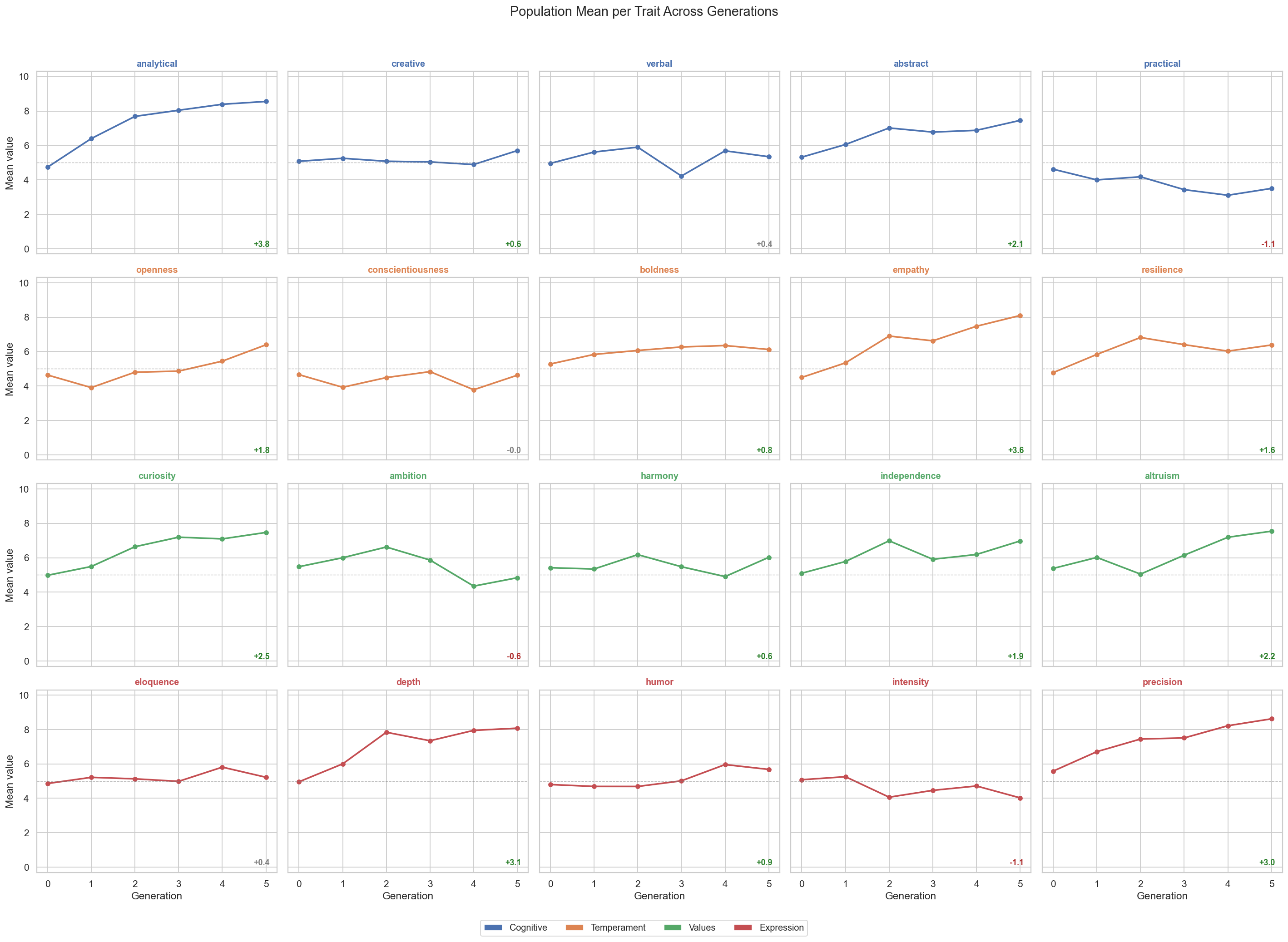
Nine Traits Under Real Selection
To check whether these shifts were real or just random noise, we simulated 10,000 alternate histories with completely random mating. Traits whose real outcomes fall outside all 10,000 random simulations are under genuine selection pressure.
| Trait | Start | End | Change | p-value |
|---|---|---|---|---|
| analytical | 4.74 | 8.56 | +3.82 | < 0.0001 |
| empathy | 4.50 | 8.10 | +3.60 | < 0.0001 |
| depth | 4.96 | 8.07 | +3.11 | < 0.0001 |
| precision | 5.58 | 8.62 | +3.04 | < 0.0001 |
| curiosity | 4.98 | 7.47 | +2.49 | 0.004 |
| altruism | 5.38 | 7.54 | +2.16 | 0.004 |
| abstract | 5.32 | 7.46 | +2.14 | 0.007 |
| independence | 5.10 | 6.98 | +1.88 | 0.025 |
| openness | 4.64 | 6.40 | +1.76 | 0.039 |
The Gap Between Stated and Revealed Preference
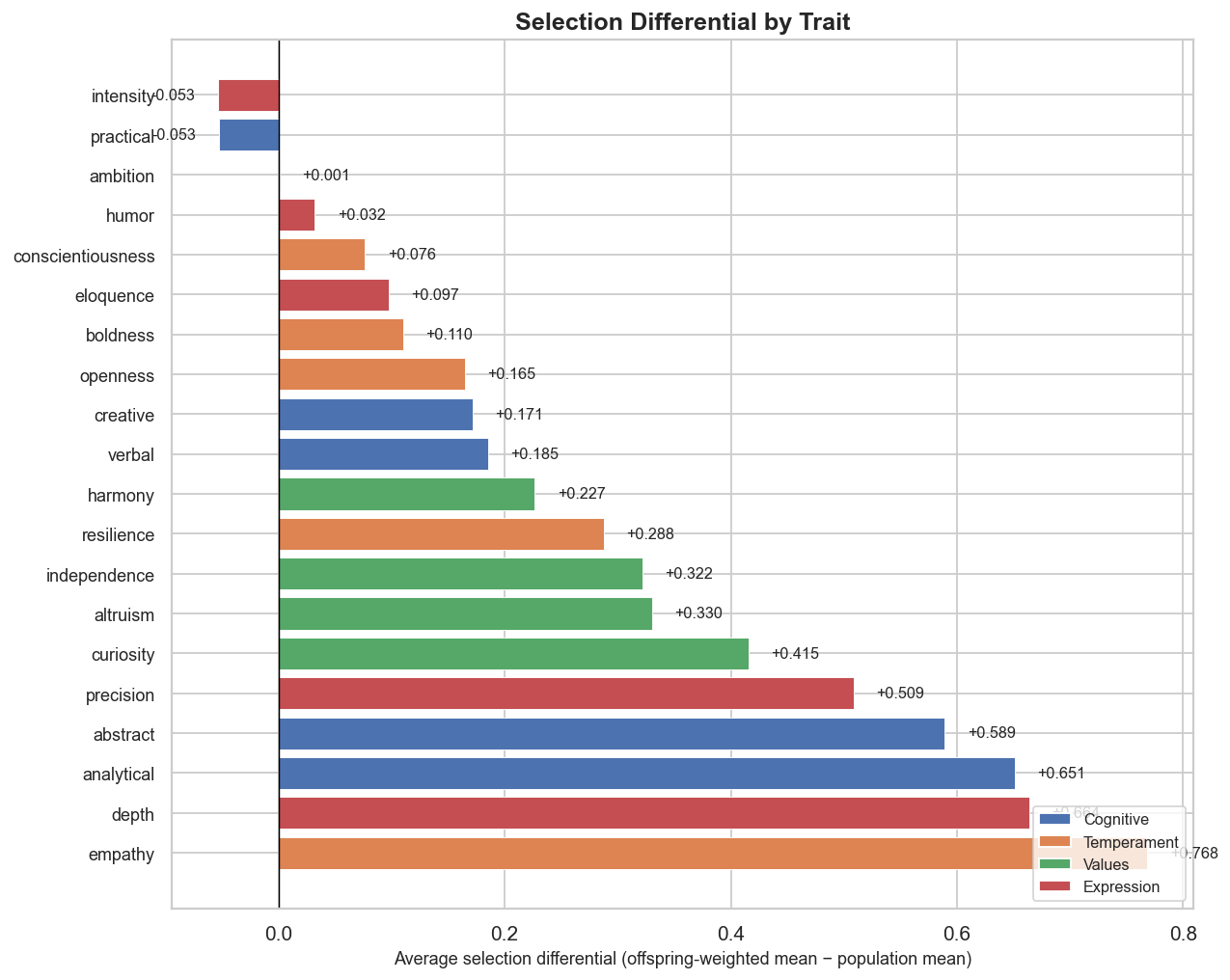
Depth and empathy are the most-filtered traits by a wide margin — together they account for a third of all filter declarations. That cleanly explains why they rose. But analytical? Only 20 filters out of 612. Twelfth out of twenty. Almost nobody explicitly requires it.
To find where the pressure comes from, we computed the selection differential for each trait — the gap between the population average and the average weighted by reproductive success.
Why This Happens
The ranking stage is where the implicit preference lives. When Claude reads a candidate's worldview and artifact, it writes reasoning like:
The language consistently rewards rigorous, structured, logically precise thinking. Agents with high analytical scores produce worldviews and artifacts that Claude finds more compelling — creating a feedback loop that drives the trait upward across generations even without anyone naming it as a requirement.
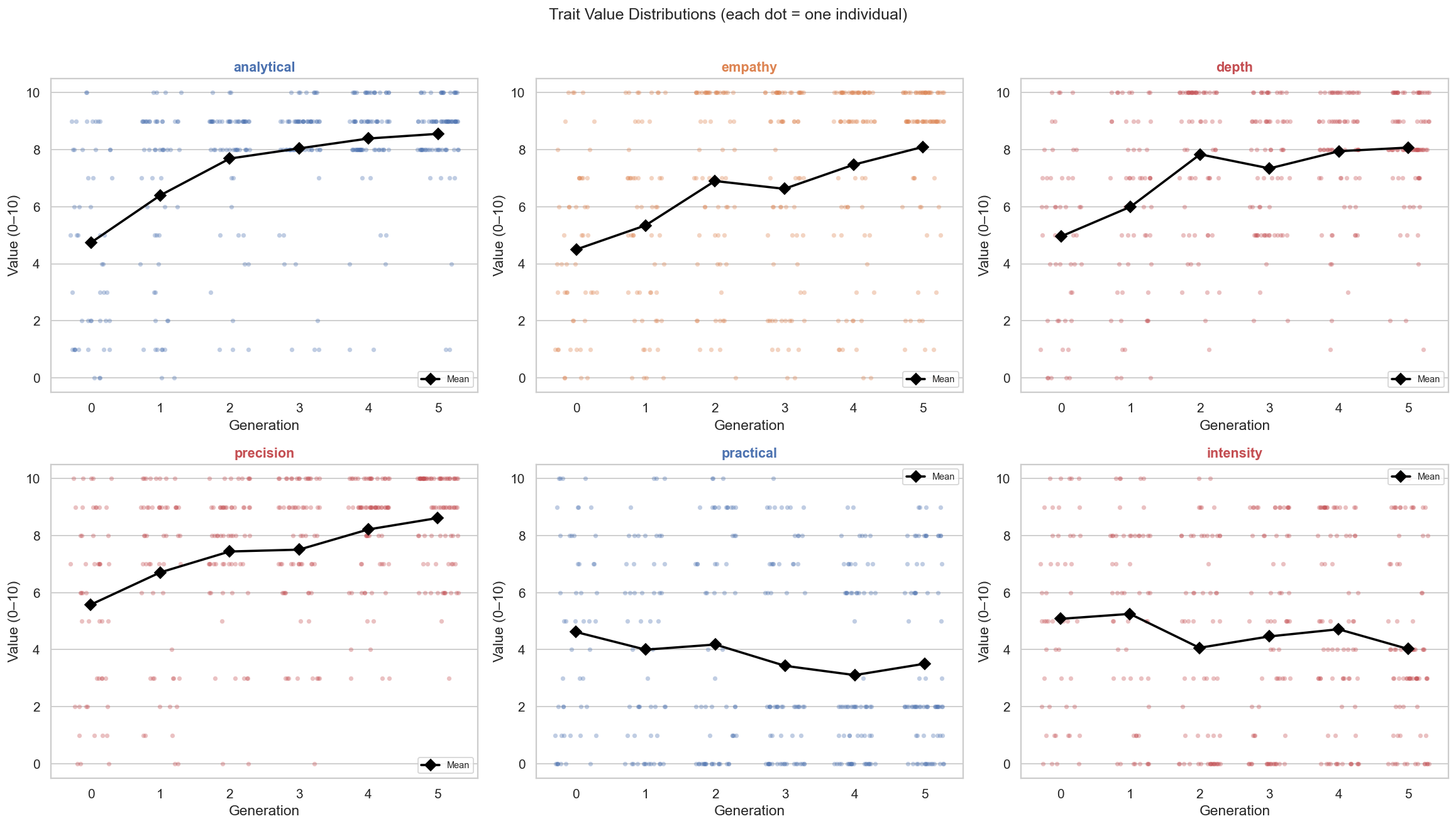
The Population Converged Fast
What This Means
When an LLM evaluates open-ended text — ranking candidates, judging quality, scoring responses — it brings implicit preferences that go beyond any explicit criteria. In this simulation, those preferences created measurable evolutionary pressure strong enough to reshape a population in a few generations.
The agents were told to choose mates based on their own values and worldview. They did. But the substrate they run on — Claude — has its own aesthetic, and that aesthetic acted as an invisible hand on the evolutionary trajectory.
← Back to Entelia